Friday, April 16, 2010

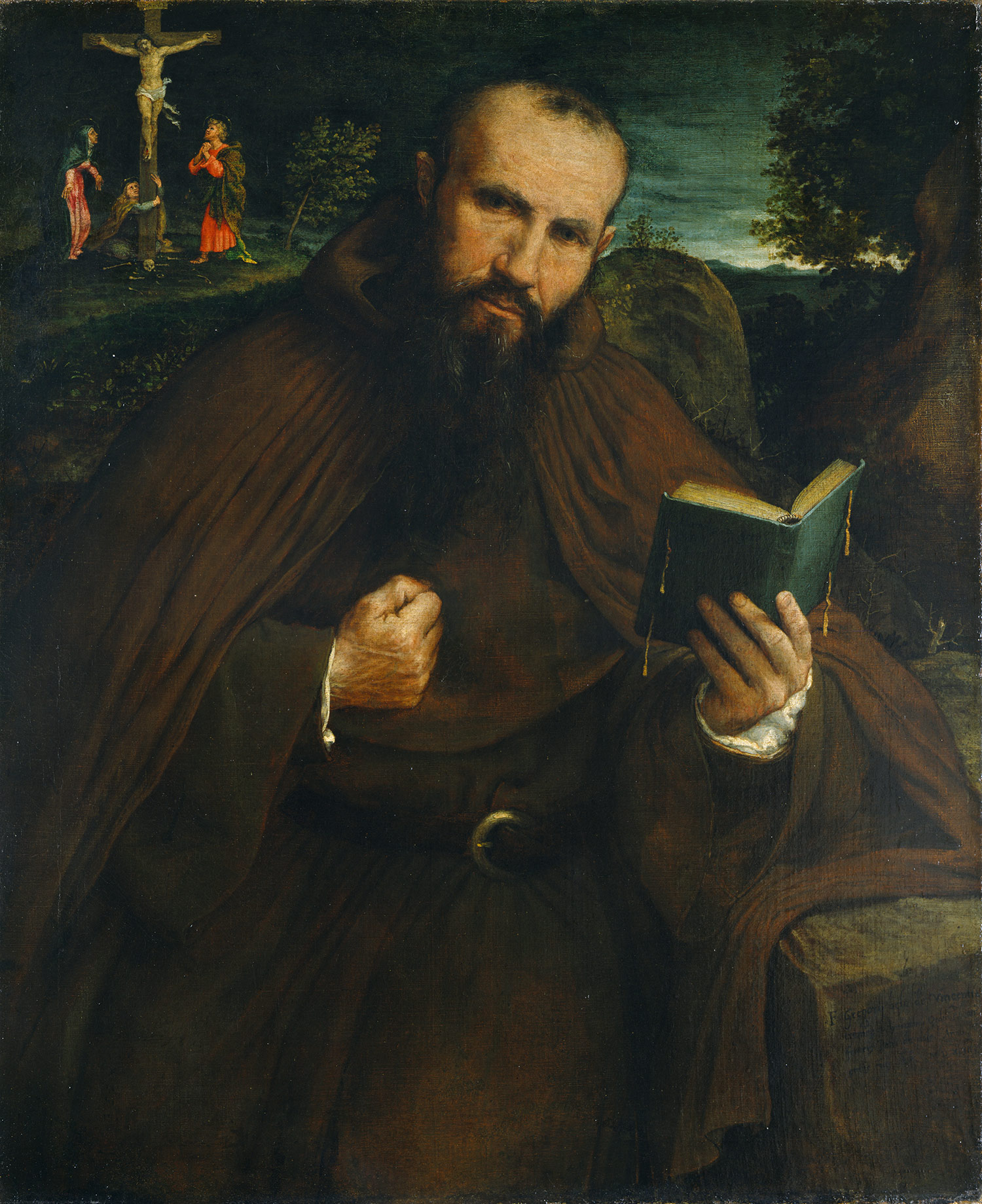
Met Image with Landscape in Background


From the Metropolitan Museum of Art:

Brother Gregorio Belo of Vicenza, 1547
Lorenzo Lotto (Italian, Venetian, ca. 1480–1556)
Oil on canvas

34 3/8 x 28 in. (87.3 x 71.1 cm)
Rogers Fund, 1965 (65.117)

The sitter holds a copy of the Homilies of Saint Gregory the Great and beats his breast. The Crucifixion is shown in the background. According to the Libro de spese (account book) of Lorenzo Lotto, the portrait was commissioned on December 9, 1546, and was completed by October 11, 1547.

Related

Thursday, April 1, 2010

Lorenzo Lotto


From Peter Humphrey, professor of Art History at St. Andrews University:

Venetian artist Lorenzo Lotto (ca. 1480-1556/7) painted some of the most startlingly beautiful as well as the most puzzling and moving works of the later Renaissance. In this generously illustrated account of Lotto's life and work, Venetian Renaissance art authority Peter Humfrey offers the first comprehensive treatment of Lotto in English since Berenson's pioneering study published one hundred years ago. Humfrey draws on the large body of Lotto's extant work as well as on sixteenth-century documentation on the artist's life, including his letters, account book for the years 1538-56, and will.

Lotto first practiced as a painter in the town of Treviso, but during his long and restless career he also spent periods in Bergamo and the Marches, as well as in Venice itself. He spent his final, lonely years at Loreto, where he died as a lay brother in a religious community. Humfrey examines the way in which Lotto responded to the work of a wide range of artists, from Giovanni Bellini and Albrecht Dürer to Raphael and Titian, but also emphasizes the painter's marked stylistic individuality, even idiosyncrasy. Particularly attractive to twentieth-century viewers are Lotto's portraits, the psychological penetration of which reveal a personality exceptionally finely attuned to the thoughts and emotions of his fellow human beings. The artist emerges as one of the most engaging and distinctive personalities of Italian Renaissance art.

National Gallery of Art on Lorenzo Lotto


From the National Gallery of Art in Washington, DC:
Lorenzo Lotto (artist)
Italian, c. 1480 - 1556/1557
Allegory of Virtue and Vice, 1505
oil on panel
Overall: 56.5 x 42.2 cm (22 1/4 x 16 5/8 in.) framed: 64.3 x 51.8 x 6.4 cm (25 5/16 x 20 3/8 x 2 1/2 in.)
Samuel H. Kress Collection
1939.1.156
On View
From the Tour: Giorgione and the High Renaissance in Venice
Object 5 of 7

This small panel originally functioned as a cover for a portrait. Covers not only protected the painting underneath, but allowed the artist to expand symbolically on particular facets of the patron's personality and concerns. This allegorical scene covered a portrait, now in Naples, of Bernardo de' Rossi, bishop of Trevisio.

Rossi had only recently survived an assassination attempt when Lotto painted him. This scene presents a view of the bishop's virtue and perseverance—and the ultimate award available to those who choose a difficult path over more immediate and worldly gratifications. The panel is clearly divided in two halves by the central tree. On the right side, a drunken satyr peers into a wine pitcher, the intoxicating liquid already spilled around him. His surroundings are lush and green, but farther in the distance a storm rises and a ship sinks below the waves. On the other side, where we find Rossi's coat-of-arms leaning against a tree, an industrious child busies himself with tools. Here the land is parched and rocky, but in the distance the same child, now with an angel's wings, climbs a hill toward a brilliant radiance. Even the tree sprouts with new life, but on the left side only. It may refer to Job 14:7: "For there is hope of a tree, if it be cut down, that it will sprout again." The bishop, like Job beset by troubles, would also flourish through steadfast virtue.

The clarity of Lotto's landscape has little to do with the soft dreaminess recently introduced by Giorgione. It shows instead the continuing influence of the kind of precision found in northern art, especially that of the German Albrecht Dürer (1471–1528), who traveled to Venice and whose works were widely known through printed engravings.
Lorenzo Lotto: "Greatest Venetian Painter after Titian"


From David Alan Brown, Italian Renaissance painting curator at the National Gallery of Art, Peter Humfrey art history professor at St. Andrew’s University, and Mauro Lucco art history professor at the Università di Bologna:

Hailed as the greatest Venetian painter after Titian, Lorenzo Lotto (c. 1480-1556) is known for a delightfully idiosyncratic artistic vision that has had special appeal for twentieth-century sensibilities. This book—which discusses Lotto’s life and work—explores the way his formal and iconographic experiments set him apart from the mainstream culture of his time.

The volume describes and reproduces paintings in most of the genres in which Lotto worked, including devotional paintings, altarpieces, portraits, and mythologies. These are arranged in chronological order from his beginnings as a pupil of Giovanni Bellini through the brilliant work of his maturity on which his reputation was based, to the end of his career in a religious community on the Adriatic coast. Focusing on his autograph paintings, the book presents such masterpieces as Saint Jerome in the Wilderness and Portrait of Andrea Odoni. The authors—David Alan Brown, Peter Humfrey, Mauro Lucco, and other eminent scholars—draw on a large number of original documents, including Lotto’s will, his letters to a confraternity in Bergamo, and his meticulously kept account books. They discuss not only Lotto’s biography and inspiration but also his mastery of allegory, his possible sympathy with the Protestant Reformation, the patrons of his altarpieces, and the so-called Lotto carpets.

This beautiful book is the catalogue for an exhibition at the National Gallery of Art, Washington, d.c., that will run from 2 November 1997 to 1 March 1998.

Lorenzo Lotto: Getty Museum

From the Getty Museum:

Lorenzo Lotto

b. about 1480 Venice, Italy, d. 1556 Loreto, Italy
Painter
Italian

Add  to Getty Bookmarks

Active in Treviso, Bergamo, and Ancona, Lorenzo Lotto spent much of his life in the provinces, where the portraits and religious paintings he specialized in often commanded higher prices than he would have received in his native Venice. According to biographer Giorgio Vasari, Lotto trained in Giovanni Bellini's studio along with Giorgione and Titian. Lotto, however, always remained somewhat apart from the dominant Venetian artistic traditions and explored a variety of painters' styles. He assimilated the work of northern Italian artists like Titian and northern European artists like Albrecht Dürer and Hans Holbein, as well as Raphael, with whom he worked in Rome on the Vatican apartments in 1508.Lotto's highly individual Mannerist style conveys devotion, humanity, interest in states of mind, and, more than his contemporaries, what was considered at the time to be an old-fashioned interest in capturing real-life appearance. Not surprisingly, he was a gifted portraitist: his three-quarter-length portraits were innovative, bold in design, and moody in atmosphere. Lotto made the unusual choice of painting in a horizontal format, which allowed him to develop ornamental patterns. In 1550 he lost his voice and part of his eyesight. He settled in a monastery at Loreto and became a lay brother in 1554.

Harvard Link to NASA ADS Article Regarding Lorenzo Lotto

From Dirk Robinson and David D. Stork:

Aberration analysis of the putative projector for Lorenzo Lotto's Husband and wife: image analysis through computer ray-tracing

Computer Image Analysis in the Study of Art. Edited by Stork, David G.; Coddington, Jim. Proceedings of the SPIE, Volume 6810, pp. 68100H-68100H-11 (2008).
A recent theory claims that the late-Italian Renaissance painter Lorenzo Lotto secretly built a concave-mirror projector to project an image of a carpet onto his canvas and trace it during the execution of Husband and wife (c. 1543). Key evidence adduced to support this claim includes "perspective anomalies" and changes in "magnification" that the theory's proponents ascribe to Lotto refocusing his projector to overcome its limitations in depth of field. We find, though, that there are important geometrical constraints upon such a putative optical projector not incorporated into the proponents' analyses, and that when properly included, the argument for the use of optics loses its force. We used Zemax optical design software to create a simple model of Lotto's studio and putative projector, and incorporated the optical properties proponents inferred from geometrical properties of the depicted carpet. Our central contribution derives from including the 116-cm-wide canvas screen; we found that this screen forces the incident light to strike the concave mirror at large angles (>= 15°) and that this, in turn, means that the projected image would reveal severe off-axis aberrations, particularly astigmatism. Such aberrations are roughly as severe as the defocus blur claimed to have led Lotto to refocus the projector. In short, we find that the projected images would not have gone in and out of focus in the way claimed by proponents, a result that undercuts their claim that Lotto used a projector for this painting. We speculate on the value of further uses of sophisticated ray-tracing analyses in the study of fine arts.